What is Generative Experience Optimization (GEO)?
Generative Experience Optimization (GEO) is the strategic practice of optimizing digital content so that Artificial Intelligence models, Large Language Models (LLMs), and generative search engines prioritize, cite, and synthesize your brand’s information in their responses. While traditional optimization focused on ranking a specific URL at the top of a static search results page, GEO focuses on becoming the definitive source of truth that an AI pulls from when constructing a multi-paragraph, conversational answer for a user.
Why GEO Matters in the AI Era
The internet is shifting from an index of links to an engine of answers. Millions of users no longer click through five different websites to piece together information; instead, they ask an AI assistant to analyze, summarize, and present the final answer directly. If your business, insights, or products are not explicitly cited inside those AI-generated answers, you effectively cease to exist for a massive and rapidly growing segment of the market. GEO ensures your brand remains visible, authoritative, and referenced in this new paradigm.
Evolution from Traditional SEO to GEO
The progression of search technology can be mapped across distinct eras:
[Traditional SEO] ───► [Semantic SEO] ───► [GEO (Generative Optimization)]
Keywords & Links Intent & Entities Synthesized Answers & AI Citations
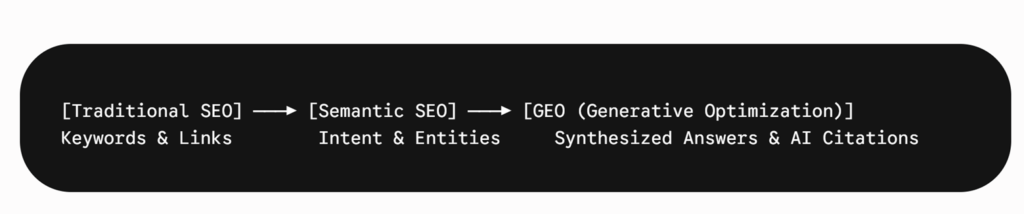
- Traditional SEO: Focused on keyword frequency, exact-match anchor text, and raw backlink volume to rank high in a list of blue links.
- Semantic SEO: Introduced structured data, entities, and search intent recognition via algorithms like RankBrain and BERT.
- GEO: Focuses on comprehensive topic coverage, immediate factual utility, structural clarity, and citation-worthiness so that an LLM selects your content to build its generative response.
How AI-Generated Search Experiences Are Changing the Internet
Generative search alters user behavior by drastically reducing the need to click away from the search page, a phenomenon known as the rise of the “zero-click search.” Users now expect immediate, highly personalized, and contextual responses. This shifts web traffic patterns; generic, high-volume informational keywords will yield fewer direct clicks to websites, while highly specific, middle-and-bottom-of-the-funnel traffic will flow to websites that the AI explicitly links to as a trusted reference.
Understanding AI-Powered Search Engines
How Generative Search Works
Generative search engines function by pairing a user’s prompt with a highly advanced retrieval and synthesis loop. When a query is entered, the engine doesn’t just look for matching keywords; it interprets the intent, builds a dynamic context window, retrieves information from its index or the live web, and uses an LLM to write a brand-new response customized to that exact user prompt.
AI Overviews and Conversational Search
Platforms like Google feature AI Overviews at the top of search engine results pages (SERPs). These overviews provide a direct answer to the query alongside a carousel of source links. Conversational search allows users to ask follow-up questions, maintaining the context of the previous turn. Optimization here requires your content to answer not just the initial question, but the logical subsequent inquiries a user might make.
Differences Between Search Engines and AI Assistants
While modern search engines use AI to summarize the web, standalone AI assistants use pre-trained internal knowledge weights, supplemented by real-time tools.
| Feature | AI-Powered Search Engines (e.g., Perplexity, Google Lens) | Pure AI Assistants (e.g., ChatGPT, Claude) |
| Primary Goal | Direct users to sources while answering queries. | Synthesize information, generate text, or execute tasks. |
| Data Retrieval | Continuous, real-time web index scanning. | Relies heavily on training data cutoffs, supplemented by web browsing modules. |
| Citation Style | Inline links, explicit source cards, carousels. | Footnotes, endnotes, or only when explicitly requested. |
Role of LLMs in Search Experiences
LLMs serve as the interface and the reasoning engine. They read thousands of words of retrieved web content in milliseconds, extract the core facts, discard fluff, and arrange the information logically. They do not rank pages based on traditional algorithmic weights alone; they evaluate how accurately, clearly, and concisely a piece of content answers the prompt relative to other retrieved documents.
Examples of AI Search Platforms
- OpenAI (ChatGPT Search): Focuses on conversational depth, blending memory, user preferences, and real-time web retrieval.
- Google: Embeds AI Overviews directly within traditional search infrastructure, leveraging the world’s largest entity graph.
- Microsoft (Copilot): Deeply integrated with the Bing index, leaning heavily on corporate and productivity ecosystem data.
- Anthropic (Claude): Emphasizes nuanced, safe, long-form analytical reasoning and document comprehension.
- Perplexity AI: An answer engine built from the ground up to prioritize direct, multi-source citations with structured user pathways.
GEO vs Traditional SEO
Major Differences Between GEO and SEO
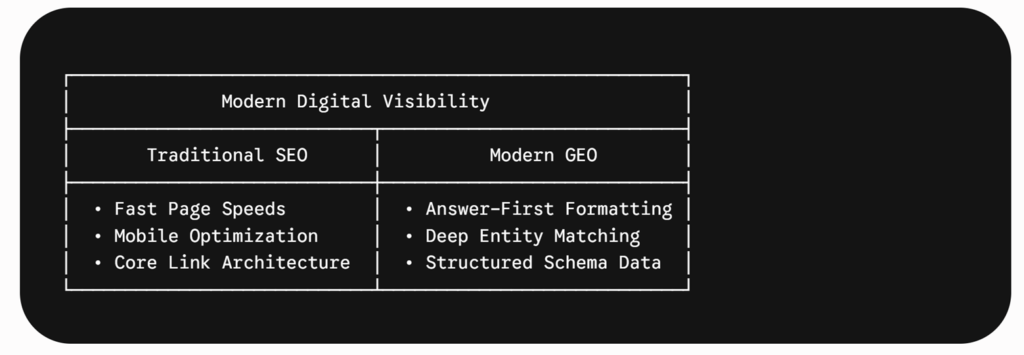
Traditional SEO optimizes for search engines so they can display a webpage to a human. GEO optimizes for AI models so they can read, understand, and reuse the content within their own generated text. The ultimate prize in SEO is position #1; the ultimate prize in GEO is becoming the trusted source link within the AI’s summary statement.
Keyword-Based Optimization vs Intent-Based Optimization
SEO historically relied on targeting specific search phrases (e.g., “SEO Expert Dubai”). GEO looks past the exact phrasing to optimize for the underlying intent and semantic context. AI search models map queries to abstract conceptual spaces, meaning your content must cover a topic with enough depth and context to match a wide variety of structurally different but conceptually identical prompts.
Search Rankings vs AI Citations
A high rank on a traditional SERP does not guarantee an AI citation. AI models prefer content that is easily digestible, structured logically, and dense with facts. A page sitting at position #4 in standard organic results might easily win the primary AI citation card if its content is formatted in a way that matches the exact informational structure the LLM needs to build its summary.
Traffic Changes in AI-Generated Search
The overall volume of informational clicks across the web is declining as AI engines satisfy quick-lookup queries natively. However, the intent of the traffic that does click through is significantly higher. When a user clicks a citation link within an AI Overview or Perplexity response, they have already passed through an informational filter and are highly qualified leads seeking deeper interaction, validation, or transaction.
Why SEO Alone Is No Longer Enough
Relying solely on traditional SEO tactics like keyword optimization, basic metadata adjustments, and backlink acquisition leaves your digital footprint invisible to conversational systems. Without clear entity associations, direct answer formats, and structural AI readability, your site will lose visibility among users who bypass standard search results entirely.
How AI Models Discover and Use Content
Crawling and Indexing in AI Systems
AI search engines utilize specific user-agent crawlers (such as GPTBot, PerplexityBot, or Google-Extended) to parse websites. Unlike traditional search crawlers that focus primarily on links and text blocks for indexing keywords, AI crawlers analyze the semantic relationships between paragraphs, headers, and entities to build a deep conceptual map of your site’s content.
Training Data vs Live Web Retrieval
LLMs operate on a dual-source paradigm:
- Training Data: Static, historical data snapshots used to teach the model grammar, logic, world facts, and broad concepts.
- Live Web Retrieval: Real-time data fetched via search APIs during a live user conversation to inject fresh, accurate information into the context window.
GEO strategies must address both. Your core brand identity should be prominent enough to exist in baseline training weights, while your functional content must be indexable for live web retrieval.
Retrieval-Augmented Generation (RAG)
RAG is the architectural backbone of modern AI search. The process unfolds in three clean steps:
[User Query] ──► [Retrieval: System pulls relevant web snippets] ──► [Generation: LLM blends snippets into a coherent answer]
To win the RAG loop, your content must contain precise, high-density informational blocks that the retrieval mechanism can easily extract and feed into the generator.
Importance of Authoritative Sources
When an AI engine retrieves ten competing articles on a topic, it uses real-time validation layers to judge which sources are the most authoritative. It looks for verifiable authorship, institutional credentials, cross-referenced data points across the web, and clean formatting. Content with clear structural authority is given priority inside the final generated output.
Semantic Understanding and Context
AI models analyze text using Natural Language Processing (NLP) models to evaluate semantic proximity. They understand that “SEO Expert,” “SEO Specialist,” and “SEO Professional” all share the same conceptual space. Therefore, creating a web of contextually rich, related vocabulary is far more effective than repeating a single primary keyword.
Entity-Based Search and Relationships
Modern AI systems view the world as a graph of Entities (people, places, organizations, concepts, and things) connected by Predicates (relationships). For example:
$$\text{SEOVOW (Entity)} \xrightarrow{\text{offers}} \text{SEO Services (Entity)} \xrightarrow{\text{located in}} \text{Dubai (Entity)}$$
GEO requires configuring your website’s copy and background code to clearly state these exact relationships, making it effortless for an AI’s knowledge graph to categorize your brand.
Core GEO Ranking Factors
Content Quality and Expertise
AI engines prioritize content that displays deep, non-generic insight. Surface-level rewriting of existing top-10 search results is easily filtered out by advanced models. Content must offer unique data, expert analysis, or un-replicated perspectives to be deemed worthy of an AI citation.
EEAT Principles
Experience, Expertise, Authoritativeness, and Trustworthiness (EEAT) are vital. AI search engines assess EEAT by validating:
- Experience: First-hand accounts, case studies, or photographic/empirical proof.
- Expertise: Author bios linked to verified digital footprints, professional certifications, and industry accolades.
- Authoritativeness: Industry recognition, citations from other trusted domains, and sustained topical focus.
- Trustworthiness: Secure web protocols, clear contact data, transparent editorial policies, and factual accuracy.
Topical Authority
Topical authority is achieved when a website comprehensively covers every sub-topic, peripheral question, and technical nuance within a specific niche.
Structured and Well-Organized Content
LLMs are highly sensitive to document structure. Content that flows logically from a high-level summary to granular breakdowns using clean heading hierarchies, ordered lists, and clear transition sentences allows the model to read, parse, and slice the text into context snippets efficiently.
Trustworthiness Signals
Beyond standard security configurations, trustworthiness signals include citing your own data sources, linking out to respected academic or governmental institutions, presenting verified customer reviews natively on the page, and maintaining an error-free, factual editorial history.
Freshness and Content Updates
For time-sensitive industries (such as corporate regulations, tax laws, or fast-evolving technology sectors), freshness is a critical filter. AI engines often look for structural timestamps (dateModified and datePublished) to ensure they are not feeding outdated parameters or obsolete guidelines into their live response windows.
Citation-Worthiness
To be cited, content must be “quotable.” This means packaging insights into sharp, undeniable sentences, unique data tables, precise definitions, or definitive statistical summaries. The easier it is for an AI to quote your sentence without needing to rewrite it extensively, the higher your citation frequency will be.
Brand Mentions Across the Web
AI models do not just look at your website; they look at what the rest of the web says about you. Unlinked brand mentions across news portals, trade forums, industry podcasts, digital directories, and social platforms contribute heavily to your brand’s entity footprint, convincing the AI that your business is a recognized authority in its space.
User Engagement Signals
Metrics such as low bounce rates, high dwell time, deep scroll depths, and direct interactions (like utilizing an on-page calculator or initiating a chat) demonstrate to web monitors and browsers that the content successfully satisfies human intent. AI search frameworks use these implicit quality signals to validate source authority.
Content Optimization for GEO
Writing for Humans and AI Simultaneously
The secret to effective GEO writing is maintaining a dual-focus approach. Write with the engaging, empathetic, and clear narrative style that human readers connect with, but arrange the structural underpinnings such as precise definitions, logical hierarchies, and factual signposts so that an LLM can easily map and extract data points.
Creating Answer-Focused Content
To capture real-time AI citations, integrate an intentional “Answer-First” framework into your articles. Start sections with a direct, single-sentence or short-paragraph answer to the primary question before diving into deeper contextual explanations, background history, or nuanced analysis.
Conversational Content Structure
Since users query AI platforms using natural, conversational language (e.g., “Who is the best SEO Expert in Dubai?”), your content structure should mirror that phrasing. Frame your subheadings as natural questions and answer them using a first-person or highly direct, advisory tone.
Topic Clustering Strategy
Organize your digital architecture into a robust hub-and-spoke configuration:
[ Pillar Page: Core Strategy Hub ]
/ | \
▼ ▼ ▼
[ Supporting Article ] [ Supporting Article ] [ Supporting Article ]
(Granular Subtopic) (Granular Subtopic) (Granular Subtopic)
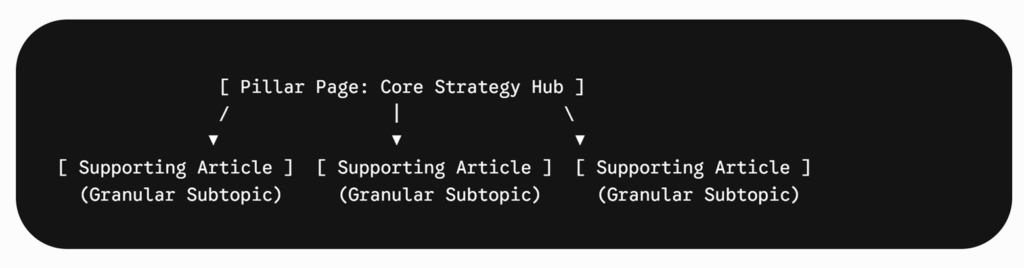
This structural interconnectedness proves to AI scrapers that your site possesses complete domain depth, rather than isolated, superficial pages.
Semantic SEO and NLP Optimization
Enhance your copy by intentionally weaving in LSI (Latent Semantic Indexing) keywords and naturally occurring co-occurring terms. If writing for instance about advanced upholstery cleaning, ensure terms like “extraction pressure,” “fiber integrity,” “surfactants,” and “drying times” are used naturally throughout the text to satisfy NLP parsing engines.
Optimizing Headings and Subheadings
Utilize clear HTML heading tags (
, , ) to form a neat hierarchy. Keep headings descriptive and functional. Instead of a creative but vague heading like “SEO in Dubai,” choose an explicit, entity-rich heading like SEO Services in Dubai
.
) to form a neat hierarchy. Keep headings descriptive and functional. Instead of a creative but vague heading like “SEO in Dubai,” choose an explicit, entity-rich heading like SEO Services in Dubai
.
FAQ Optimization
Incorporate dedicated FAQ modules within your content strategy. Craft questions directly from real user search inputs and follow them with precise, jargon-free, objective answers. This layout perfectly matches the data structure AI models seek when building quick-reference panels.
Summaries and Concise Explanations
Place a TL;DR (Too Long; Didn’t Read) or an executive summary box at the absolute top of long-form guides. This provides an optimized, ready-made summary block that an LLM can easily pull directly into an AI Overview carousel or response window.
Using Statistics and Research-Backed Data
AI models love hard data. Whenever you make a claim, support it with exact percentages, numerical metrics, or verifiable historical figures, and format them clearly. For instance, writing “Our method improves efficiency by 34%” provides a firm, structured fact that an AI can easily quote as an authoritative data point.
Internal Linking Strategy
Maintain a methodical internal linking ecosystem. Use descriptive, entity-focused anchor texts rather than generic terms like “click here” or “read more”. Linking related articles together helps AI crawlers map the context and trace the semantic relationships between different pages on your site.
Technical GEO Best Practices
Website Crawlability
Ensure your technical foundation is entirely accessible to AI web crawlers. Check your robots.txt configuration to confirm that you have not accidentally blocked specific automated agents like GPTBot or Google-Extended from reading your high-value resource directories.
Fast-Loading Websites
AI real-time retrieval systems operate under extreme latency constraints. If your webpage takes several seconds to load, an AI’s real-time RAG system will timeout and skip your URL entirely, pulling a fact from a faster-loading competitor instead. Prioritize clean code, compressed assets, and fast hosting.
Mobile Optimization
With a vast majority of conversational searches occurring on mobile devices and within voice-activated applications, your web architecture must be fully responsive, lightweight, and perfectly readable across all screen configurations.
Structured Data/Schema Markup
Schema markup acts as an explicit translation layer between your human-readable text and an AI’s database. By embedding clean structured data into your site’s code, you remove all ambiguity, telling the AI exactly what your content represents, who authored it, and what entities are involved.
XML Sitemaps
Keep your XML sitemaps highly organized, dynamically updated, and submitted cleanly to search consoles. This ensures that whenever you publish fresh insights or update a regulatory guide, AI indexing systems can discover and analyze the changes almost immediately.
Canonical URLs
Prevent index bloating and internal content competition by implementing self-referential canonical tags across your site. This tells AI scrapers exactly which page version is the authoritative master copy, consolidating your technical authority signals perfectly.
HTTPS and Security
An unsecure website is an untrusted website. AI retrieval systems actively filter out non-HTTPS links to protect users from malicious environments. Ensure your SSL certificates are perfectly configured, valid, and consistently renewed.
Accessibility Optimization
Clean HTML structures that follow accessibility guidelines (such as descriptive image alt text, aria-labels, and logical tab-indexing) do double duty: they make your site easily navigable for disabled individuals and highly scannable for automated AI parsers.
AI-Readable Website Architecture
Keep your directory setups shallow and organized. A clean, flat structural flow like [domain.com/services/SEO](https://domain.com/services/SEO) is significantly easier for an automated AI processing routine to crawl, comprehend, and map than an unorganized, deeply buried path like [domain.com/folder1/p=98734/subpage-xyz](https://domain.com/folder1/p=98734/subpage-xyz).
Structured Data and Schema Markup
What Is Schema Markup?
Schema markup is a standardized vocabulary of structured microdata tags that you add to your HTML. Developed by a collaboration of major search engines, this code helps search engines and AI networks understand the explicit meaning behind your content, turning unstructured text into rich, actionable data.
Why Schema Matters for AI Search
While an LLM is skilled at inferring meaning from text, schema markup provides undeniable, structured proof. It gives the AI a clear roadmap of facts, eliminating any guesswork regarding numbers, addresses, authors, relationships, or business operations.
Important Schema Types
- Article Schema: Explicitly identifies the headline, author, publisher, publication date, and modification timestamps of editorial content.
- FAQ Schema: Maps out specific question-and-answer pairings so AI engines can easily extract and display them directly in search windows.
- Organization Schema: Defines your brand name, official logos, social profiles, corporate relationships, and operational headquarters.
- Product Schema: Highlights specific items for sale, including pricing, real-time availability, dimensions, and manufacturing data.
- Review Schema: Houses aggregate user ratings, individual scores, and critic summaries, verifying real-world reputation.
- Local Business Schema: Provides critical regional coordinates, operating hours, service footprints, and direct phone contacts.
JSON-LD Implementation Best Practices
The preferred format for implementing schema markup is JSON-LD (JavaScript Object Notation for Linked Data), placed cleanly within the header block of your HTML. Ensure your JSON-LD syntax is completely valid, avoids nested formatting errors, and matches the on-page text perfectly to maintain absolute integrity.
JSON
{
“@context”: “https://schema.org”,
“@type”: “LocalBusiness”,
“name”: “SEOVOW”,
“address”: {
“@type”: “PostalAddress”,
“addressLocality”: “Dubai”,
“addressRegion”: “DXB”,
“addressCountry”: “AE”
},
“url”: “https://www.seovow.com”,
“telephone”: “+97140000000”
}
Creating AI-Friendly Content
How AI Interprets Content
AI systems interpret text by breaking down sentences into distinct tokens and calculating the contextual probability weights between them. The clearer your sentences are, the easier it is for the AI model to accurately interpret your claims, catalog your insights, and reuse them down the line.
Using Simple and Clear Language
Avoid overly dense, poetic, or unnecessarily complex prose. Use straightforward, active-voice sentence structures. Instead of writing, “An elite methodology is executed by our team to rejuvenate textiles,” write simply: “We use advanced German technology to deep-clean luxury sofas.”
Avoiding Ambiguity
Vague statements, mixed metaphors, and loose pronouns can confuse automated parsing engines. Be explicit with your subjects. Instead of saying, “This company helps you do that there,” state clearly, “SEO VOW assists entrepreneurs with SEO services in Dubai.”
Creating Factual and Verifiable Content
Ensure your assertions are completely accurate, transparent, and verifiable. If you present a claim, anchor it within historical consensus, established legal codes, or verified scientific parameters. AI validation filters routinely cross-check retrieved data against trusted baseline facts to filter out hallucinations and misleading information.
Optimizing for Featured Snippets and AI Summaries
To capture featured snippets and AI summaries, frame your core answer in a highly compact, structured snippet directly below the main target question. Use formatting options like:
- A concise 40-50 word text block for direct definition queries.
- An explicitly ordered
- list for step-by-step process breakdowns.
- A clean, well-labeled HTML table for data or feature comparisons.
Importance of Context and Completeness
Never leave an architectural thought half-finished. When explaining a process, cover the prerequisites, the actual core execution steps, and the immediate next steps or outcomes. Comprehensive completeness signals to an AI that your document is a single, self-sufficient resource worth citing.
Using Examples, Tables, and Definitions
Break up long narrative passages with clear illustrations. Use