
What is Generative Experience Optimization (GEO)?
Generative Experience Optimization (GEO) is the strategic practice of optimizing digital content so that Artificial Intelligence models, Large Language Models (LLMs), and generative search engines prioritize, cite, and synthesize your brand’s information in their responses. While traditional optimization focused on ranking a specific URL at the top of a static search results page, GEO focuses on becoming the definitive source of truth that an AI pulls from when constructing a multi-paragraph, conversational answer for a user.
Why GEO Matters in the AI Era
The internet is shifting from an index of links to an engine of answers. Millions of users no longer click through five different websites to piece together information; instead, they ask an AI assistant to analyze, summarize, and present the final answer directly. If your business, insights, or products are not explicitly cited inside those AI-generated answers, you effectively cease to exist for a massive and rapidly growing segment of the market. GEO ensures your brand remains visible, authoritative, and referenced in this new paradigm.
Evolution from Traditional SEO to GEO
The progression of search technology can be mapped across distinct eras:
[Traditional SEO] ───► [Semantic SEO] ───► [GEO (Generative Optimization)]
Keywords & Links Intent & Entities Synthesized Answers & AI Citations
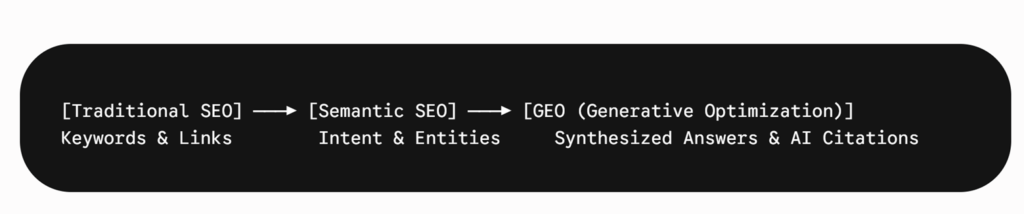
- Traditional SEO: Focused on keyword frequency, exact-match anchor text, and raw backlink volume to rank high in a list of blue links.
- Semantic SEO: Introduced structured data, entities, and search intent recognition via algorithms like RankBrain and BERT.
- GEO: Focuses on comprehensive topic coverage, immediate factual utility, structural clarity, and citation-worthiness so that an LLM selects your content to build its generative response.
How AI-Generated Search Experiences Are Changing the Internet
Generative search alters user behavior by drastically reducing the need to click away from the search page, a phenomenon known as the rise of the “zero-click search.” Users now expect immediate, highly personalized, and contextual responses. This shifts web traffic patterns; generic, high-volume informational keywords will yield fewer direct clicks to websites, while highly specific, middle-and-bottom-of-the-funnel traffic will flow to websites that the AI explicitly links to as a trusted reference.
Understanding AI-Powered Search Engines
How Generative Search Works
Generative search engines function by pairing a user’s prompt with a highly advanced retrieval and synthesis loop. When a query is entered, the engine doesn’t just look for matching keywords; it interprets the intent, builds a dynamic context window, retrieves information from its index or the live web, and uses an LLM to write a brand-new response customized to that exact user prompt.
AI Overviews and Conversational Search
Platforms like Google feature AI Overviews at the top of search engine results pages (SERPs). These overviews provide a direct answer to the query alongside a carousel of source links. Conversational search allows users to ask follow-up questions, maintaining the context of the previous turn. Optimization here requires your content to answer not just the initial question, but the logical subsequent inquiries a user might make.
Differences Between Search Engines and AI Assistants
While modern search engines use AI to summarize the web, standalone AI assistants use pre-trained internal knowledge weights, supplemented by real-time tools.
| Feature | AI-Powered Search Engines (e.g., Perplexity, Google Lens) | Pure AI Assistants (e.g., ChatGPT, Claude) |
| Primary Goal | Direct users to sources while answering queries. | Synthesize information, generate text, or execute tasks. |
| Data Retrieval | Continuous, real-time web index scanning. | Relies heavily on training data cutoffs, supplemented by web browsing modules. |
| Citation Style | Inline links, explicit source cards, carousels. | Footnotes, endnotes, or only when explicitly requested. |
Role of LLMs in Search Experiences
LLMs serve as the interface and the reasoning engine. They read thousands of words of retrieved web content in milliseconds, extract the core facts, discard fluff, and arrange the information logically. They do not rank pages based on traditional algorithmic weights alone; they evaluate how accurately, clearly, and concisely a piece of content answers the prompt relative to other retrieved documents.
Examples of AI Search Platforms
- OpenAI (ChatGPT Search): Focuses on conversational depth, blending memory, user preferences, and real-time web retrieval.
- Google: Embeds AI Overviews directly within traditional search infrastructure, leveraging the world’s largest entity graph.
- Microsoft (Copilot): Deeply integrated with the Bing index, leaning heavily on corporate and productivity ecosystem data.
- Anthropic (Claude): Emphasizes nuanced, safe, long-form analytical reasoning and document comprehension.
- Perplexity AI: An answer engine built from the ground up to prioritize direct, multi-source citations with structured user pathways.
GEO vs Traditional SEO
Major Differences Between GEO and SEO
Traditional SEO optimizes for search engines so they can display a webpage to a human. GEO optimizes for AI models so they can read, understand, and reuse the content within their own generated text. The ultimate prize in SEO is position #1; the ultimate prize in GEO is becoming the trusted source link within the AI’s summary statement.
Keyword-Based Optimization vs Intent-Based Optimization
SEO historically relied on targeting specific search phrases (e.g., “SEO Expert Dubai”). GEO looks past the exact phrasing to optimize for the underlying intent and semantic context. AI search models map queries to abstract conceptual spaces, meaning your content must cover a topic with enough depth and context to match a wide variety of structurally different but conceptually identical prompts.
Search Rankings vs AI Citations
A high rank on a traditional SERP does not guarantee an AI citation. AI models prefer content that is easily digestible, structured logically, and dense with facts. A page sitting at position #4 in standard organic results might easily win the primary AI citation card if its content is formatted in a way that matches the exact informational structure the LLM needs to build its summary.
Traffic Changes in AI-Generated Search
The overall volume of informational clicks across the web is declining as AI engines satisfy quick-lookup queries natively. However, the intent of the traffic that does click through is significantly higher. When a user clicks a citation link within an AI Overview or Perplexity response, they have already passed through an informational filter and are highly qualified leads seeking deeper interaction, validation, or transaction.
Why SEO Alone Is No Longer Enough
Relying solely on traditional SEO tactics like keyword optimization, basic metadata adjustments, and backlink acquisition leaves your digital footprint invisible to conversational systems. Without clear entity associations, direct answer formats, and structural AI readability, your site will lose visibility among users who bypass standard search results entirely.
How AI Models Discover and Use Content
Crawling and Indexing in AI Systems
AI search engines utilize specific user-agent crawlers (such as GPTBot, PerplexityBot, or Google-Extended) to parse websites. Unlike traditional search crawlers that focus primarily on links and text blocks for indexing keywords, AI crawlers analyze the semantic relationships between paragraphs, headers, and entities to build a deep conceptual map of your site’s content.
Training Data vs Live Web Retrieval
LLMs operate on a dual-source paradigm:
- Training Data: Static, historical data snapshots used to teach the model grammar, logic, world facts, and broad concepts.
- Live Web Retrieval: Real-time data fetched via search APIs during a live user conversation to inject fresh, accurate information into the context window.
GEO strategies must address both. Your core brand identity should be prominent enough to exist in baseline training weights, while your functional content must be indexable for live web retrieval.
Retrieval-Augmented Generation (RAG)
RAG is the architectural backbone of modern AI search. The process unfolds in three clean steps:
[User Query] ──► [Retrieval: System pulls relevant web snippets] ──► [Generation: LLM blends snippets into a coherent answer]
To win the RAG loop, your content must contain precise, high-density informational blocks that the retrieval mechanism can easily extract and feed into the generator.
Importance of Authoritative Sources
When an AI engine retrieves ten competing articles on a topic, it uses real-time validation layers to judge which sources are the most authoritative. It looks for verifiable authorship, institutional credentials, cross-referenced data points across the web, and clean formatting. Content with clear structural authority is given priority inside the final generated output.
Semantic Understanding and Context
AI models analyze text using Natural Language Processing (NLP) models to evaluate semantic proximity. They understand that “SEO Expert,” “SEO Specialist,” and “SEO Professional” all share the same conceptual space. Therefore, creating a web of contextually rich, related vocabulary is far more effective than repeating a single primary keyword.
Entity-Based Search and Relationships
Modern AI systems view the world as a graph of Entities (people, places, organizations, concepts, and things) connected by Predicates (relationships). For example:
$$\text{SEOVOW (Entity)} \xrightarrow{\text{offers}} \text{SEO Services (Entity)} \xrightarrow{\text{located in}} \text{Dubai (Entity)}$$
GEO requires configuring your website’s copy and background code to clearly state these exact relationships, making it effortless for an AI’s knowledge graph to categorize your brand.
Core GEO Ranking Factors
Content Quality and Expertise
AI engines prioritize content that displays deep, non-generic insight. Surface-level rewriting of existing top-10 search results is easily filtered out by advanced models. Content must offer unique data, expert analysis, or un-replicated perspectives to be deemed worthy of an AI citation.
EEAT Principles
Experience, Expertise, Authoritativeness, and Trustworthiness (EEAT) are vital. AI search engines assess EEAT by validating:
- Experience: First-hand accounts, case studies, or photographic/empirical proof.
- Expertise: Author bios linked to verified digital footprints, professional certifications, and industry accolades.
- Authoritativeness: Industry recognition, citations from other trusted domains, and sustained topical focus.
- Trustworthiness: Secure web protocols, clear contact data, transparent editorial policies, and factual accuracy.
Topical Authority
Topical authority is achieved when a website comprehensively covers every sub-topic, peripheral question, and technical nuance within a specific niche.
Structured and Well-Organized Content
LLMs are highly sensitive to document structure. Content that flows logically from a high-level summary to granular breakdowns using clean heading hierarchies, ordered lists, and clear transition sentences allows the model to read, parse, and slice the text into context snippets efficiently.
Trustworthiness Signals
Beyond standard security configurations, trustworthiness signals include citing your own data sources, linking out to respected academic or governmental institutions, presenting verified customer reviews natively on the page, and maintaining an error-free, factual editorial history.
Freshness and Content Updates
For time-sensitive industries (such as corporate regulations, tax laws, or fast-evolving technology sectors), freshness is a critical filter. AI engines often look for structural timestamps (dateModified and datePublished) to ensure they are not feeding outdated parameters or obsolete guidelines into their live response windows.
Citation-Worthiness
To be cited, content must be “quotable.” This means packaging insights into sharp, undeniable sentences, unique data tables, precise definitions, or definitive statistical summaries. The easier it is for an AI to quote your sentence without needing to rewrite it extensively, the higher your citation frequency will be.
Brand Mentions Across the Web
AI models do not just look at your website; they look at what the rest of the web says about you. Unlinked brand mentions across news portals, trade forums, industry podcasts, digital directories, and social platforms contribute heavily to your brand’s entity footprint, convincing the AI that your business is a recognized authority in its space.
User Engagement Signals
Metrics such as low bounce rates, high dwell time, deep scroll depths, and direct interactions (like utilizing an on-page calculator or initiating a chat) demonstrate to web monitors and browsers that the content successfully satisfies human intent. AI search frameworks use these implicit quality signals to validate source authority.
Content Optimization for GEO
Writing for Humans and AI Simultaneously
The secret to effective GEO writing is maintaining a dual-focus approach. Write with the engaging, empathetic, and clear narrative style that human readers connect with, but arrange the structural underpinnings such as precise definitions, logical hierarchies, and factual signposts so that an LLM can easily map and extract data points.
Creating Answer-Focused Content
To capture real-time AI citations, integrate an intentional “Answer-First” framework into your articles. Start sections with a direct, single-sentence or short-paragraph answer to the primary question before diving into deeper contextual explanations, background history, or nuanced analysis.
Conversational Content Structure
Since users query AI platforms using natural, conversational language (e.g., “Who is the best SEO Expert in Dubai?”), your content structure should mirror that phrasing. Frame your subheadings as natural questions and answer them using a first-person or highly direct, advisory tone.
Topic Clustering Strategy
Organize your digital architecture into a robust hub-and-spoke configuration:
[ Pillar Page: Core Strategy Hub ]
/ | \
▼ ▼ ▼
[ Supporting Article ] [ Supporting Article ] [ Supporting Article ]
(Granular Subtopic) (Granular Subtopic) (Granular Subtopic)
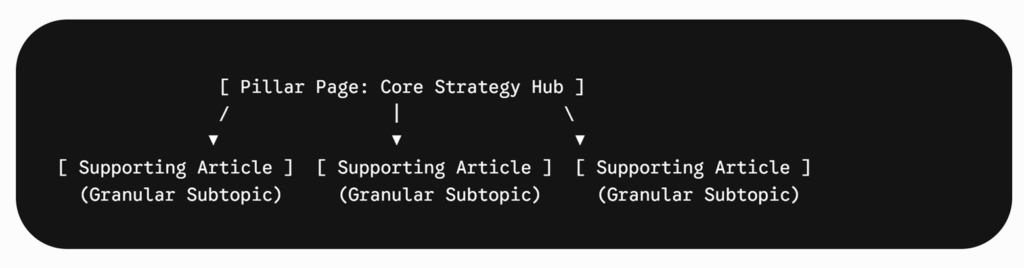
This structural interconnectedness proves to AI scrapers that your site possesses complete domain depth, rather than isolated, superficial pages.
Semantic SEO and NLP Optimization
Enhance your copy by intentionally weaving in LSI (Latent Semantic Indexing) keywords and naturally occurring co-occurring terms. If writing for instance about advanced upholstery cleaning, ensure terms like “extraction pressure,” “fiber integrity,” “surfactants,” and “drying times” are used naturally throughout the text to satisfy NLP parsing engines.
Optimizing Headings and Subheadings
Utilize clear HTML heading tags (<h1>, <h2>, <h3>) to form a neat hierarchy. Keep headings descriptive and functional. Instead of a creative but vague heading like “SEO in Dubai,” choose an explicit, entity-rich heading like <h2>SEO Services in Dubai</h2>.
FAQ Optimization
Incorporate dedicated FAQ modules within your content strategy. Craft questions directly from real user search inputs and follow them with precise, jargon-free, objective answers. This layout perfectly matches the data structure AI models seek when building quick-reference panels.
Summaries and Concise Explanations
Place a TL;DR (Too Long; Didn’t Read) or an executive summary box at the absolute top of long-form guides. This provides an optimized, ready-made summary block that an LLM can easily pull directly into an AI Overview carousel or response window.
Using Statistics and Research-Backed Data
AI models love hard data. Whenever you make a claim, support it with exact percentages, numerical metrics, or verifiable historical figures, and format them clearly. For instance, writing “Our method improves efficiency by 34%” provides a firm, structured fact that an AI can easily quote as an authoritative data point.
Internal Linking Strategy
Maintain a methodical internal linking ecosystem. Use descriptive, entity-focused anchor texts rather than generic terms like “click here” or “read more”. Linking related articles together helps AI crawlers map the context and trace the semantic relationships between different pages on your site.
Technical GEO Best Practices
Website Crawlability
Ensure your technical foundation is entirely accessible to AI web crawlers. Check your robots.txt configuration to confirm that you have not accidentally blocked specific automated agents like GPTBot or Google-Extended from reading your high-value resource directories.
Fast-Loading Websites
AI real-time retrieval systems operate under extreme latency constraints. If your webpage takes several seconds to load, an AI’s real-time RAG system will timeout and skip your URL entirely, pulling a fact from a faster-loading competitor instead. Prioritize clean code, compressed assets, and fast hosting.
Mobile Optimization
With a vast majority of conversational searches occurring on mobile devices and within voice-activated applications, your web architecture must be fully responsive, lightweight, and perfectly readable across all screen configurations.
Structured Data/Schema Markup
Schema markup acts as an explicit translation layer between your human-readable text and an AI’s database. By embedding clean structured data into your site’s code, you remove all ambiguity, telling the AI exactly what your content represents, who authored it, and what entities are involved.
XML Sitemaps
Keep your XML sitemaps highly organized, dynamically updated, and submitted cleanly to search consoles. This ensures that whenever you publish fresh insights or update a regulatory guide, AI indexing systems can discover and analyze the changes almost immediately.
Canonical URLs
Prevent index bloating and internal content competition by implementing self-referential canonical tags across your site. This tells AI scrapers exactly which page version is the authoritative master copy, consolidating your technical authority signals perfectly.
HTTPS and Security
An unsecure website is an untrusted website. AI retrieval systems actively filter out non-HTTPS links to protect users from malicious environments. Ensure your SSL certificates are perfectly configured, valid, and consistently renewed.
Accessibility Optimization
Clean HTML structures that follow accessibility guidelines (such as descriptive image alt text, aria-labels, and logical tab-indexing) do double duty: they make your site easily navigable for disabled individuals and highly scannable for automated AI parsers.
AI-Readable Website Architecture
Keep your directory setups shallow and organized. A clean, flat structural flow like [domain.com/services/SEO](https://domain.com/services/SEO) is significantly easier for an automated AI processing routine to crawl, comprehend, and map than an unorganized, deeply buried path like [domain.com/folder1/p=98734/subpage-xyz](https://domain.com/folder1/p=98734/subpage-xyz).
Structured Data and Schema Markup
What Is Schema Markup?
Schema markup is a standardized vocabulary of structured microdata tags that you add to your HTML. Developed by a collaboration of major search engines, this code helps search engines and AI networks understand the explicit meaning behind your content, turning unstructured text into rich, actionable data.
Why Schema Matters for AI Search
While an LLM is skilled at inferring meaning from text, schema markup provides undeniable, structured proof. It gives the AI a clear roadmap of facts, eliminating any guesswork regarding numbers, addresses, authors, relationships, or business operations.
Important Schema Types
- Article Schema: Explicitly identifies the headline, author, publisher, publication date, and modification timestamps of editorial content.
- FAQ Schema: Maps out specific question-and-answer pairings so AI engines can easily extract and display them directly in search windows.
- Organization Schema: Defines your brand name, official logos, social profiles, corporate relationships, and operational headquarters.
- Product Schema: Highlights specific items for sale, including pricing, real-time availability, dimensions, and manufacturing data.
- Review Schema: Houses aggregate user ratings, individual scores, and critic summaries, verifying real-world reputation.
- Local Business Schema: Provides critical regional coordinates, operating hours, service footprints, and direct phone contacts.
JSON-LD Implementation Best Practices
The preferred format for implementing schema markup is JSON-LD (JavaScript Object Notation for Linked Data), placed cleanly within the header block of your HTML. Ensure your JSON-LD syntax is completely valid, avoids nested formatting errors, and matches the on-page text perfectly to maintain absolute integrity.
JSON
{
“@context”: “https://schema.org”,
“@type”: “LocalBusiness”,
“name”: “SEOVOW”,
“address”: {
“@type”: “PostalAddress”,
“addressLocality”: “Dubai”,
“addressRegion”: “DXB”,
“addressCountry”: “AE”
},
“url”: “https://www.seovow.com”,
“telephone”: “+97140000000”
}
Creating AI-Friendly Content
How AI Interprets Content
AI systems interpret text by breaking down sentences into distinct tokens and calculating the contextual probability weights between them. The clearer your sentences are, the easier it is for the AI model to accurately interpret your claims, catalog your insights, and reuse them down the line.
Using Simple and Clear Language
Avoid overly dense, poetic, or unnecessarily complex prose. Use straightforward, active-voice sentence structures. Instead of writing, “An elite methodology is executed by our team to rejuvenate textiles,” write simply: “We use advanced German technology to deep-clean luxury sofas.”
Avoiding Ambiguity
Vague statements, mixed metaphors, and loose pronouns can confuse automated parsing engines. Be explicit with your subjects. Instead of saying, “This company helps you do that there,” state clearly, “SEO VOW assists entrepreneurs with SEO services in Dubai.”
Creating Factual and Verifiable Content
Ensure your assertions are completely accurate, transparent, and verifiable. If you present a claim, anchor it within historical consensus, established legal codes, or verified scientific parameters. AI validation filters routinely cross-check retrieved data against trusted baseline facts to filter out hallucinations and misleading information.
Optimizing for Featured Snippets and AI Summaries
To capture featured snippets and AI summaries, frame your core answer in a highly compact, structured snippet directly below the main target question. Use formatting options like:
- A concise 40-50 word text block for direct definition queries.
- An explicitly ordered <ol> list for step-by-step process breakdowns.
- A clean, well-labeled HTML table for data or feature comparisons.
Importance of Context and Completeness
Never leave an architectural thought half-finished. When explaining a process, cover the prerequisites, the actual core execution steps, and the immediate next steps or outcomes. Comprehensive completeness signals to an AI that your document is a single, self-sufficient resource worth citing.
Using Examples, Tables, and Definitions
Break up long narrative passages with clear illustrations. Use <table> tags to display contrasting options, blockquotes to highlight core definitions, and specific bullet points to present examples. This visual variation allows AI parsers to categorize and index distinct data points easily.
GEO Content Formats That Perform Best
Long-Form Guides
Deep-dive, comprehensive pillar guides (ranging from 2,000 to 5,000 words) perform exceptionally well in GEO. They provide an exhaustive collection of context, related entities, and answers, making them an excellent all-in-one resource for AI engines to extract information from.
Expert Roundups
Articles that gather distinct insights, direct quotes, and specialized commentary from multiple verified industry leaders establish significant authority signals. The presence of numerous named experts creates a high-density web of trusted entity relationships on a single page.
Case Studies
Real-world case studies provide the empirical, proof-heavy content that AI models favor. Structuring a case study with clear headings such as The Challenge, The Strategy, The Execution, and The Quantifiable Results offers verifiable, real-world data points that are highly citable.
Step-by-Step Tutorials
Clear, actionable walkthroughs that outline exactly how to solve a problem provide immense functional utility. Organizing tutorials with numbered headers (e.g., Step 1, Step 2) allows conversational assistants to easily relay instructions directly to users looking for help.
FAQs
Dedicated, comprehensive FAQ pages or sections operate as direct answer repositories. They match the natural Q&A conversational loop of AI interfaces, allowing systems to easily fetch a clean answer to a specific question.
Comparison Articles
Articles that compare different options (e.g., Company A vs Company B, or Service X vs Service Y) provide structured analysis. Using clear comparison metrics and summary tables allows an AI shopping or research assistant to quickly synthesize the pros and cons for a user.
Statistics Pages
Aggregating industry data, trends, and key metrics into a dedicated, frequently updated resource page creates a powerful hub for citations. When researchers or AI systems need a reliable data point, they will link back to your page as the original or definitive compiler of that data.
Glossaries
An index of industry-specific terms and their precise definitions provides a highly clear semantic blueprint. Glossaries help anchor your site’s entity relationships, making it a valuable reference point for AI systems looking to define technical terms.
Research-Driven Content
Publishing original surveys, proprietary market research, or unique experimental data is one of the most effective ways to earn authoritative citations. Original findings cannot be replicated by AI text summaries alone, forcing the AI engine to cite your brand as the primary source of the new data.
Topical Authority in GEO
Building Content Silos
Content silos are structured architecture frameworks that group related content into distinct, isolated sections based on topic. By keeping your internal linking and topic focuses organized within clear silos, you establish an undeniable map of subject-matter expertise.
Covering Topics Comprehensively
To build true topical authority, you cannot simply scratch the surface. You must write about the historical background, the current applications, the future trends, the common pitfalls, the regulatory impacts, and the specific peripheral tools associated with that specific niche.
Content Depth and Breadth
- Depth: How far down the rabbit hole you go into a specific problem, outlining advanced mechanics, edge cases, and technical details.
- Breadth: How widely you cover related subtopics across the industry, ensuring no logical gaps are left unaddressed.
Pillar Pages and Supporting Articles
Your pillar page serves as the comprehensive overview hub for a major topic space. It then branches out to dozens of supporting cluster articles that dive deep into specific subheadings, with each supporting article linking cleanly back to the main pillar page.
Consistency in Publishing
Topical authority is not a one-time project; it requires ongoing care. Maintaining a steady, consistent cadence of publishing fresh insights and updating older articles signals to AI crawlers that your platform is an active, reliable source of current industry knowledge.
Brand Authority and Digital PR
Importance of Online Reputation
AI engines are highly risk-aversive; they avoid recommending or citing brands with poor online reputations, unresolved complaints, or inconsistent public data. Maintaining a clean digital footprint across the web is an essential pillar of broad GEO success.
Building Brand Mentions
Focus on generating natural mentions of your brand name across high-authority websites, industry news hubs, and community forums. Even if these mentions do not include a direct backlink, AI models still register the association, building your brand’s presence in their internal knowledge graphs.
Digital PR Strategies
Shift your PR focus from low-quality link building to high-impact story placement. Pitch original insights, unique data findings, and expert opinions to major industry publications, ensuring your brand is positioned as a thought leader in real-world discussions.
Guest Posting
Publishing high-quality guest contributions on respected industry websites expands your entity reach. Ensure your guest content meets the same rigorous standards as your own site’s content, complete with a verified author bio that links back to your main digital profiles.
Expert Interviews
Participating in or hosting expert interviews creates a strong web of professional associations. When an AI crawler parses an interview connecting your name with established industry leaders, it updates its network to reflect your growing authority.
HARO and Journalist Outreach
Engaging with journalist platforms (such as Connectively/HARO or Featured) allows you to provide rapid, expert commentary to reporters drafting articles. Winning these press citations places your brand into highly trusted news feeds that AI models frequently use for real-time web retrieval.
Social Proof and Reviews
Actively manage your presence across major independent review ecosystems (such as Google Business Profile, Trustpilot, or industry-specific directories). A consistent stream of positive, detailed user reviews provides strong real-world proof of your business’s trustworthiness and reliability.
GEO for Local Businesses
AI Search and Local Intent
When a user asks an AI assistant for a local service (e.g., “Best SEO Experts in Dubai”), the system uses location data and business profiles to generate a tailored recommendation. Local GEO focuses on positioning your business as the clear choice for these conversational, location-based queries.
Optimizing Local Business Profiles
Ensure your Google Business Profile, Apple Maps Connect, and Bing Places profiles are completely filled out, perfectly accurate, and consistent. Use identical formatting for your Name, Address, and Phone number (NAP data) across every platform to prevent any identity confusion.
Importance of Reviews and Ratings
AI systems look closely at the sentiment, frequency, and detail of your customer reviews. A review that explicitly describes your service (e.g., “Pay our SEO services only after ranking on the first page”) provides rich contextual data that helps the AI understand your specific specialties.
Local Schema Markup
Embed detailed LocalBusiness or specialized industry schema directly into your web code. Clearly define your geographic service area boundaries, operational hours, and specific neighborhood coordinates to make your local presence clear to AI systems.
Hyperlocal Content Strategies
Write content tailored to your specific community. Create guides that discuss neighborhood-specific regulations, environmental conditions (like handling dust and humidity in regional climates), or local case studies. This establishes strong hyperlocal authority that general national competitors cannot match.
GEO for Service-Based Businesses
For service-based businesses operating without a physical retail storefront, optimization relies on creating clear, dedicated service-area pages. Each page should feature unique local customer testimonials, distinct project portfolios, and clear, structured maps of your coverage zones.
GEO for E-Commerce Websites
AI-Driven Product Discovery
AI shopping assistants don’t just display a list of product photos; they read product descriptions, analyze customer reviews, compare technical specifications, and explain why a specific product matches the user’s unique needs. E-commerce GEO centers on feeding these shopping assistants clear, detailed product data.
Product Page Optimization
Move past basic, manufacturer-provided product descriptions. Write clear, detail-rich copy that outlines exactly what the product is made of, its precise dimensions, use-case examples, performance metrics, and care instructions.
Product Schema Markup
Implement robust Product schema on every item page. Ensure you include real-time parameters for price, priceCurrency, availability (e.g., InStock), sku, mpn, and brand. This structured data allows AI shopping systems to confidently recommend your products with accurate pricing and availability details.
Review Optimization
Incorporate structured Review and AggregateRating schema into your product pages. Showcasing verified customer feedback directly in your code allows AI engines to quickly pull real-world ratings and display them in conversational comparison panels.
AI Shopping Assistants
Understand that AI shopping assistants look for compatibility, value, and specific user preferences. By structuring your content to answer common buyer questions (e.g., “Is this stroller suitable for air travel?”), you help the AI match your product to highly specific buyer criteria.
Conversational Commerce
Prepare your e-commerce ecosystem for conversational interactions by creating detailed buying guides, sizing assistants, and product matching matrices. This clear information can easily be pulled into automated chat interfaces and conversational search systems.
GEO for Service Businesses
Creating Trust-Driven Content
Service businesses are built entirely on trust. Because clients cannot look at a physical product before purchasing, your content must emphasize your operational safety standards, industry certifications, transparent pricing models, and clear service guarantees to build confidence.
Service Page Optimization
Every service you offer should have its own dedicated, high-quality page. Avoid bundling distinct services onto a single, generic overview page. A dedicated page for a specialized service allows you to build complete topical depth and clear entity focus around that specific offering.
Local Authority Building
Establish deep roots within your operational market by publishing case studies of completed projects in your target areas, highlighting your compliance with regional regulations, and participating actively in local business associations and trade networks.
Lead Generation Through AI Search
To capture valuable leads via AI search, make your inquiry process incredibly simple and direct. Offer clear, value-driven next steps such as an automated quote calculator, a direct scheduling calendar, or a prominent, one-click WhatsApp contact option directly within your content.
Case Studies and Testimonials
Feature detailed, real-world customer stories prominently on your service pages. Use the exact words of your clients to describe the challenges they faced and how your team resolved them, providing authentic social proof that AI engines can easily reference.
GEO and Voice Search Optimization
Rise of Voice Assistants
With the widespread adoption of smart speakers, mobile voice commands, and advanced voice modes, more searches are being spoken rather than typed. Voice search optimization requires adapting your content to match the natural patterns of spoken language.
Conversational Queries
Spoken queries are naturally longer, more informal, and phrased as complete sentences. While a typed search might be “corporate tax Dubai registration”, a spoken voice query is more likely to be: “What are the exact steps I need to follow to register for corporate tax in Dubai?” Your content must align with these conversational sentence structures.
Natural Language Optimization
Write your content using a natural, fluid speaking cadence. Read your key informational passages aloud; if a sentence feels awkward, overly long, or difficult to say in one breath, revise it for clarity and simplicity so voice assistants can easily read it back to users.
Question-Based Content Strategy
Build a comprehensive framework around the primary question words: Who, What, Where, When, Why, and How. Organizing your content to address these direct questions ensures you are well-positioned to capture the voice response snippets delivered by smart devices.
Mobile Voice Search Trends
Most mobile voice searches are action-oriented and highly time-sensitive, often focused on immediate local needs (e.g., finding a service nearby while driving). Ensure your core local data, contact numbers, and operational hours are clean, clear, and easy for mobile voice systems to locate instantly.
AI Search User Behavior
Zero-Click Searches
As AI search platforms provide complete, synthesized answers directly on the results page, the volume of traditional web clicks for basic lookups is declining. To succeed in a zero-click environment, your optimization goal must expand beyond earning traffic to winning high-visibility brand citations and trusted authority links.
Conversational Browsing
Users are learning to interact with search engines as active research partners, refining their queries over multi-step conversations (e.g., “Show me the top choices. Now filter out options without a physical office. Now show me their contact options”). Your content needs the depth to remain relevant throughout these multi-step research journeys.
Intent-Based Discovery
In generative search, user intent is discovered through context. AI platforms evaluate a user’s previous questions, past preferences, and current situational context to customize their responses. Aligning your content with distinct stages of the customer journey ensures your brand is visible when the right intent triggers a recommendation.
Changes in Click-Through Rates
Traditional search traffic followed a steep curve where the top few organic spots captured almost all clicks. In AI search, click distribution shifts; highly visible citation boxes, resource carousels, and inline links draw highly targeted clicks from deeply engaged users.
How Users Interact with AI-Generated Answers
Users typically read the AI summary first to get a quick overview, then look at the accompanying source citations to verify facts, explore specific details, or take action. Winning a place within these source cards positions your brand at the exact point where a user transitions from research to action.
Measuring GEO Performance
GEO KPIs and Metrics
Tracking your performance in a generative search landscape requires updating your analytics playbook. Focus on tracking your brand’s overall visibility within AI modules, your total share of voice across LLM responses, and the direct conversion rates driven by referral traffic from AI platforms.
Tracking AI Visibility
Monitor how often your website’s content appears within generative answer frames, AI Overviews, and conversational carousels across major platforms. This broad visibility metric serves as your new baseline for digital presence in an AI-first environment.
Monitoring Citations in AI Responses
Keep close track of the specific URLs from your domain that AI platforms choose to cite, noting which topics and content structures earn the most references. Understanding what the AI prefers to quote allows you to replicate those successful frameworks across the rest of your site.
Organic Traffic Analysis
Isolate and analyze the referral traffic hitting your site from AI domains (such as perplexity.ai, openai.com, or specific search engine AI subdomains). Evaluate the on-page behavior, dwell times, and conversion paths of these visitors to measure the real-world value of your GEO efforts.
Brand Mention Tracking
Use advanced social listening and web monitoring tools to track all instances of your brand name across the wider web. Monitoring your overall mention volume and sentiment helps you understand how effectively your digital PR efforts are building your brand entity.
User Engagement Metrics
Analyze your deep on-page engagement signals, including scroll tracking, internal click-through rates, form completions, and interaction times. High user engagement confirms to search frameworks that your content is genuinely helpful to human readers, protecting your long-term authority status.
GEO Tools and Platforms
AI SEO Tools
Utilize modern SEO suites (such as advanced modules in Semrush, Ahrefs, or specialized AI tracking platforms) that offer dedicated monitoring for AI Overviews, tracking whether your target keywords trigger generative answers and identifying which sites secure the citations.
Content Optimization Tools
Leverage advanced NLP and semantic analysis platforms (such as MarketMuse, SurferSEO, or Clearscope) to evaluate your content’s topic depth. These tools compare your text against the broader web landscape, highlighting any gaps in your entity coverage or vocabulary.
Entity Optimization Tools
Use specialized tools to analyze how effectively search engines map your brand’s entity graph. Platforms like WordLift help you build custom internal knowledge graphs, creating structured relationships between your pages and recognized industry concepts.
Schema Markup Generators
Simplify your structured data implementation by using trusted schema validation and generation tools (such as the Schema.org community tools, Merkle’s Schema Generator, or Google’s Rich Results Test) to build, test, and verify your JSON-LD code blocks.
Analytics Platforms
Configure your primary web analytics tools (like Google Analytics 4) with custom filters and referral segments designed to cleanly isolate, measure, and track incoming traffic originating from generative AI and conversational search platforms.
AI Monitoring Tools
Stay ahead of the curve by using emerging monitoring platforms built specifically to run automated queries across various LLM models. These tools track how different AI engines describe your brand, services, and core products, helping you spot and correct any visibility gaps.
GEO Best Practices Checklist
Content Quality Checklist
- Does the content deliver fresh, non-generic analysis or original insights?
- Is the copy completely accurate, verifiable, and free of misleading claims?
- Are the author’s professional credentials and industry experience clearly displayed?
- Does the article cover the target topic completely, leaving no major subtopics unaddressed?
- Is the writing style clear, engaging, and polished for human readers?
Technical Optimization Checklist
- Are all high-value content directories completely accessible to AI web crawlers?
- Does the website load fast, passing standard speed performance tests?
- Is the entire digital experience fully responsive and mobile-friendly?
- Does the site use a clean, shallow, easily crawlable directory structure?
- Is the entire domain fully secured using valid HTTPS protocols?
AI-Readability Checklist
- Is the text structured logically with descriptive HTML heading tags (<h1>-<h3>)?
- Does the content feature an answer-first layout, providing direct answers early?
- Are complex insights broken up with clear bullet points, numbered steps, or summaries?
- Are key industry terms and related vocabulary used naturally throughout the copy?
- Are important facts presented in clean, easily scannable data tables?
Authority-Building Checklist
- Is your brand name mentioned regularly across trusted industry news hubs and forums?
- Do you have a consistent stream of detailed, positive reviews on independent platforms?
- Are your digital PR efforts focused on securing placements in respected publications?
- Do your content hubs use a clean pillar-and-cluster internal linking framework?
- Are your expert contributors actively building verified digital footprints?
Schema Implementation Checklist
- Is your structured data implemented cleanly using valid JSON-LD code?
- Have you applied detailed Article schema to all editorial and blog content?
- Are your service locations, hours, and contacts defined via LocalBusiness schema?
- Do your product pages feature accurate schema for price, availability, and reviews?
- Have you verified your code using trusted rich-results testing tools?
Common GEO Mistakes to Avoid
Keyword Stuffing
Attempting to trick AI models by over-optimizing for specific keywords or forcing unnatural phrases into your text does not work. Modern LLMs look past basic keyword density to evaluate semantic depth and flow; stuffing keywords only hurts readability and triggers quality spam filters.
Thin AI-Generated Content
Flooding your website with low-cost, unedited, generic AI-generated text creates a weak digital footprint. AI search engines can easily recognize repetitive, low-effort summaries that offer no new data, resulting in your content being filtered out of retrieval loops.
Ignoring EEAT
Failing to clearly display your real-world credentials, expert authors, verifiable sources, and institutional trust markers makes your content appear unreliable. Without strong trust signals, AI engines will skip your pages to avoid sharing unverified information.
Lack of Structure
Presenting your insights in long, unbroken walls of text without clear headings, logical sections, or list elements makes it incredibly difficult for an AI scraper to parse your data accurately. Unstructured content is easily passed over for well-organized alternatives.
Outdated Content
Leaving older, time-sensitive guides on your site without regular updates, current regulatory parameters, or fresh data metrics damages your reliability score. AI models look for clear freshness timestamps and will discard obsolete articles.
Weak Authority Signals
Operating in digital isolation without earning outside brand mentions, secure press placements, high-quality reviews, or authoritative backlinks prevents you from building a strong entity footprint, keeping your business invisible to broader AI engines.
Over-Automation
Automating your entire content creation, translation, and technical deployment process without human oversight introduces errors, formatting bugs, and hollow messaging. Keep a skilled human expert in the loop to protect your brand’s voice and quality standards.
GEO Strategy for the Future
Future of AI Search
The future of search belongs to platforms that can intuitively blend real-time multi-source data retrieval, contextual memory, and predictive reasoning to answer complex user requests before they are even fully phrased.
Search Generative Experience (SGE)
As generative frameworks become deeply integrated into standard search engines worldwide, traditional search layouts will continue to evolve, turning standard result pages into dynamic, interactive dashboards of synthesized knowledge.
Personalized AI Results
AI search experiences will become highly customized to the individual user, tailoring recommendations based on past choices, immediate context, and specific career or lifestyle needs. Your GEO strategy must build deep contextual relevance to fit these personalized criteria.
Multimodal Search
Users are increasingly searching using a mix of text, spoken voice commands, live video feeds, and images. Optimizing for this multimodal future means your assets including videos, graphics, audio, and text must be clearly labeled and contextually connected.
AI Agents and Autonomous Browsing
We are moving toward a world where autonomous AI agents handle research, comparison shopping, and service booking on behalf of users. GEO will expand to optimize for these digital agents, ensuring your technical parameters allow them to easily evaluate and select your business.
Predictions for GEO in the Next 5 Years
Over the next five years, traditional keyword tracking will largely phase out, replaced by comprehensive share-of-voice monitoring within AI engines. The brands that win will be those that establish an undeniable reputation as the definitive, trusted source of truth within their market space.
Final Thoughts
Why GEO Is Becoming Essential
Embracing Generative Experience Optimization is no longer an optional strategy for forward-thinking businesses; it is a fundamental requirement for long-term digital survival. As AI systems continue to redefine how the world finds information, your optimization strategy must adapt to stay relevant.
Balancing SEO and GEO
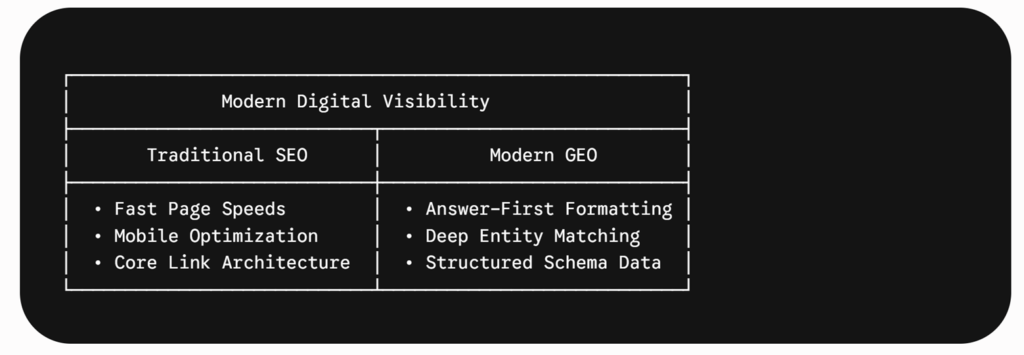
GEO does not mean throwing out your established SEO playbook; it means expanding it. The technical fundamentals of classic SEO such as fast page speeds, clean site code, and quality backlinks provide the foundation that allows your advanced GEO strategies to succeed.
┌─────────────────────────────────────────────────────────┐
│ Modern Digital Visibility │
├────────────────────────────┬────────────────────────────┤
│ Traditional SEO │ Modern GEO │
├────────────────────────────┼────────────────────────────┤
│ • Fast Page Speeds │ • Answer-First Formatting │
│ • Mobile Optimization │ • Deep Entity Matching │
│ • Core Link Architecture │ • Structured Schema Data │
└────────────────────────────┴────────────────────────────┘
Long-Term Content Strategy
Build a sustainable digital footprint by consistently investing in high-quality, original research, deep educational resources, and a pristine online reputation. Focus on creating content that genuinely serves your audience, keeping your brand authoritative and reliable for years to come.
Preparing Websites for AI-First Search Experiences
Take the time to evaluate your digital content and website. Clean up your site architecture, fix any crawl blocks, add detailed structured schema, and ensure your content delivers clear, direct value. By making your platform highly accessible to AI engines, you position your brand to thrive as the internet evolves into an AI-first landscape.